 CAUTION: Do not drive the vehicle if the fluid level is below the bottom hole on the fluid level indicator (7A020) and outside temperatures are above 10°C (50°F).
Section 07-01B: Transmission, Automatic, C6 | 1996 F-250 4x2 and 4x4; F-350 4x2 and 4x4 Workshop Manual |
The following items must be checked prior to beginning the diagnostic procedures:
Know and Understand the Concern
In order to properly diagnose a concern, you must first understand the customer complaint or condition. Customer contact may be required in order for the technician to begin to verify the concern. You must understand the conditions under which the concern occurs. For example:
After understanding when and how the concern occurs, proceed to verifying the concern.
Verification of Concern
The following procedures are recommended for checking and/or verifying that the various components are adjusted and operating properly.
Determine Customer Concern
Determine customer's concern and know when it exists.
Check transmission fluid level and condition. Check for contamination or burnt odor. Check for leaks.
Check Fluid Level and Condition
Fluid Level Check
Ford automatic transmissions use Motorcraft MERCON® ATF XT-2-QDX or -DDX or MERCON® equivalent. Before adding any fluid, be sure that the correct type will be used.
CAUTION: Do not drive the vehicle if the fluid level is below the bottom hole on the fluid level indicator (7A020) and outside temperatures are above 10°C (50°F).
Under normal circumstances, you do not need to check the fluid level of the transmission since your vehicle does not use up transmission fluid. However, if the transmission is not working properly — for instance, the transmission may slip or shift slowly, or if you notice some sign of fluid leakage — the fluid level should be checked.
It is preferable to check the transmission fluid level at normal operating temperature, after approximately 32 km (20 miles) of driving. However, if necessary, you can check the fluid level without driving to obtain a normal operating temperature if outside temperatures are above 10°C (50°F).
NOTE: If the vehicle has been operated for an extended period at high speeds, in city traffic during hot weather or pulling a trailer, the vehicle should be turned off for about 30 minutes to allow the fluid to cool before checking.
With vehicle on a level surface, start the engine and move the gearshift lever (7210) through all of the gear ranges allowing sufficient time for each position to engage. Securely latch the gearshift lever in the park position, fully set the parking brake and leave the engine running.
Wipe off the oil level indicator cap, pull the fluid level indicator out and wipe the indicator end clean. Put the filler tube back into the fluid and make sure it is fully seated. Pull the fluid level indicator out and read the fluid level.
When checking fluid at normal operating temperature, the fluid level should be within the crosshatched area on the fluid level indicator. When the vehicle has not been driven and outside temperature is above 10°C (50°F), the fluid level should be between the holes on the fluid level indicator.
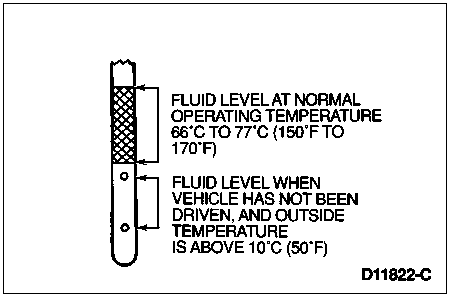
High or Low Fluid Level
A fluid level that is too high will cause the fluid to become aerated. Aerated fluid will cause low control pressure, and the aerated fluid may be forced out the vent (7034).
Low fluid level may be the cause of transmission slippage or non-engagement. Fluid level may indicate fluid leaks that could cause transmission damage.
High or Low Fluid Level, High Level Before Start, Normal OK
It is normal for the fluid level to be high prior to the engine starting. The torque converter (7902) will drain due to the absence of a drainback valve. All clutch assemblies of the transmission will drain to the sump also, causing fluid level to be high.
Adding Fluid
If you need to add fluid, first check for the correct type (MERCON®) stamped on the fluid indicator. Before adding any fluid, be sure that the correct type will be used.
CAUTION: Use of any fluid other than specified could result in transmission malfunction or failure.
Add fluid in 0.25-liter (0.5-pint) increments through the fluid filler tube to bring the level to the correct area on the fluid level indicator. If an overfill occurs, excess fluid should be removed by draining. Refer to Transmission Fluid Drain and Refill Procedures in the Removal portion of this section.
Fluid Change — Drain/Refill
Normal maintenance and lubrication do not necessitate periodic automatic transmission fluid changes.
To remove excess fluid, disconnect the cooler IN line at the cooler. Attach a rubber hose to the line and insert the other end into a drain pan. Crank the engine for a short period of time (do not allow the engine to start) to remove a quantity of transmission fluid. Reattach the cooler line to the cooler. Start the engine. Move the gearshift lever through all gear ranges. Recheck the fluid for the proper level. Continue to add or subtract fluid until the proper level is reached. If a major service (clutch, band, bearing, etc.) is required, the unit will have to be removed. At this time, the torque converter, transmission cooler, and cooler lines must be flushed to remove any contaminants. Refer to Transmission Fluid Cooler and Lines, Backflush/Cleaning in the Diagnosis and Testing portion of this section for instructions on proper cleaning and flushing of those components.
When used under severe duty conditions the transmission fluid filter/screen assembly should be replaced. The transmission fluid should be drained from the transmission and torque converter and refilled with MERCON® fluid as specified to the proper level every 33,800 km (21,000 miles).
When filling a dry transmission and torque converter, refer to Specifications portion of this section for capacity. Check the fluid level.
Procedures for Drain and Refill
CAUTION: Use only MERCON® service fluid as the use of any other fluids may result in a transmission malfunction or failure.
Severe Duty/Major Overhaul
Refer to Transmission Fluid Drain and Refill Procedures in the Removal portion of this section.
Fluid Condition Check
NOTE: Fluid used with the automatic transmission contains a detergent that retains particles in suspension generated during normal transmission use. This characteristic may result in a dark coloring of the fluid and does not by itself indicate malfunction or need for repair.
If particles are present in the fluid or there is evidence of coolant, the transmission fluid pan must be removed for further inspection. If fluid contamination or transmission failure is confirmed by further evidence of coolant or excessive solids in the transmission fluid pan, the transmission must be disassembled and completely cleaned and repaired. This includes cleaning the torque converter (if applicable) and transmission cooling system. Do not perform any further checks before cleaning and repairing the transmission.
Make the normal fluid check according to the above procedure.
Observe color and odor of the fluid. It should be dark reddish not brown or black.
Use a clean, lint-free rag to wipe the fluid level indicator. Examine the stain for evidence of solids (specks of any kind) and for coolant signs (gum or varnish on fluid level indicator).
Road Testing Vehicle
The following Shift Point Road Test provides diagnostic information on transmission shift controls and operation.
Shift Point Road Test
This check will determine if the governor pressure and shift control valves are functioning properly.
Check the minimum throttle upshifts in D (drive). The transmission should begin in 1st gear, shift to 2nd, and then shift to 3rd, within the shift points listed in the following chart.
| Throttle Position | Range | Shift | km/ha Range | mpha Range |
|---|---|---|---|---|
| Minimum Throttle | D | 1-2 | 8-29 | 5-18 |
| Minimum Throttle | D | 2-3 | 10-40 | 6-25 |
| Closed Throttle | D | 3-1 | 8-14 | 5-9 |
| Closed Throttle | 1 | 2-1 | 26-58 | 16-36 |
| Part Throttle (to Detent) | D | 1-2 | 30-72 | 19-45 |
| Part Throttle (to Detent) | D | 2-3 | 51-113 | 32-70 |
| Max. Downshift (to Detent) | D | 3-2 | 40-97 | 25-60 |
| Wide-Open Throttle (WOT) | D | 1-2 | 43-76 | 27-47 |
| Wide-Open Throttle (WOT) | D | 2-3 | 76-121 | 47-75 |
| Max. Downshift (WOT) | D | 3-2 | 66-106 | 41-66 |
| Max. Downshift (WOT) | D | 3-1 | 29-55 | 18-34 |
Forced Downshifts
With the transmission in 3rd gear, depress the accelerator pedal through the detent (to the floor). The transmission should shift from 3rd to 2nd unless vehicle is traveling above downshift lock-out speed, or 3rd to 1st (perform at 15-20 mph).
Closed Throttle Downshifts
Check the closed throttle downshift from 3rd to 1st by coasting down from about 48 km (30 mph) in 3rd gear. The shift should occur within the limits listed in Specifications at the end of this section.
Manual Downshifts
When the gearshift lever is at 2 (2nd), the transmission can operate only in 2nd gear.
With the transmission in 3rd gear and road speed over 80 km (50 mph) the transmission should shift to 2nd gear when the gear selector lever is moved from D (drive) to 2 (2nd) or 1 (1st).
The transmission will downshift from 3rd to 2nd to 1st gear when this same manual shift is made below approximately 30 km (18 mph).
Refer to the band application chart to aid in diagnosis of transmission conditions.
| Gear | Holding Members | Forward Planetary Gearset | Rear Planetary Gearset | ||||
|---|---|---|---|---|---|---|---|
| Driven | Held | Output | Driven | Held | Output | ||
| Manual Low 1 | Forward Clutch Assembly and Reverse Clutch | Forward Ring Gear | Forward Planeta | Sun Gear | Sun Gear | Rear Planet | Ring Gear |
| D Low | Forward Clutch Assembly and One-Way Clutch | Forward Ring Gear | Forward Planeta | Sun Gear | Sun Gear | Rear Planet | Ring Gear |
| D Second or 2 | Forward Clutch Assembly and Intermediate Band | Forward Ring Gear | Sun Gear | Forward Planet | Effectively in Neutral | ||
| High | Forward Clutch Assembly and Direct Clutch Assembly | Sun Gear Forward Ring Gear | None | Forward Planet | Turns As a Unit | ||
| Reverse | Reverse Clutch Assembly and Direct Clutch Assembly | Effectively in Neutral | Sun Gear | Rear Planet Carrier | Ring Gear | ||
Visual Inspection
This inspection will identify modifications or additions to the vehicle operation system that may affect diagnosis.
Check TSBs and OASIS
Refer to all technical service bulletins and OASIS messages that pertain to the transmission concern and follow the procedure as outlined.