Speed Control System Components
Section 10-03: Speed Control System, Electronic | 1996 F-150, F-250, F-350, F-Super Duty and Bronco Workshop Manual |
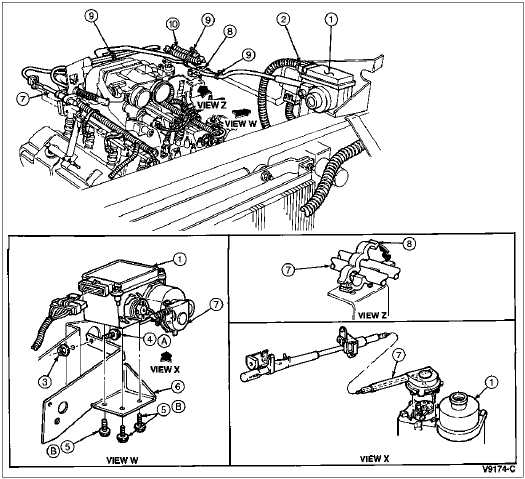
The speed control system is designed to maintain vehicle speed automatically at any driver-selected speed above approximately 48 km/h (30 mph) and below approximately 201 km/h (125 mph). The system is comprised of a speed control servo (9C735) which consists of a speed control actuator cable (9A825) with integrated electronics and other parts including horn relay, driver control switches, a stoplight switch (13480) and a deactivator switch. The speed signal is generated by the programmable speedometer/odometer module (PSOM) on all vehicles but motorhome. On motorhome, the speed signal is generated by the speed sensor located in the parking brake assembly. The speed control servo is mounted in the engine compartment and is connected to the throttle linkage with a speed control actuator cable.
Diagnosis and testing of the speed control system used on the 7.3L diesel engine can be found in the Powertrain Control/Emissions Diagnosis Manual OBDI or OBDII.
Speed Control System Components
| Item | Part Number | Description |
|---|---|---|
| 1 | 9C735 | Speed Control Servo |
| 2 | 12A581 | Engine Control Sensor Wiring |
| 3 | N620421-S2 | Nut |
| 4 | N605786-S2 | Bolt |
| 5 | N806515-S2 | Screw |
| 6 | 9C736 | Bracket |
| 7 | 9A825 | Speed Control Actuator Cable |
| 8 | N804323-S | Clip |
| 9 | 95875-S | Strap |
| 10 | 9D930 | Fuel Charging Wiring |
| A | — | Tighten to 21-32 Nm (16-23 Lb-Ft) |
| B | — | Tighten to 8-10 Nm (6-8 Lb-Ft) |
Deactivator Switch
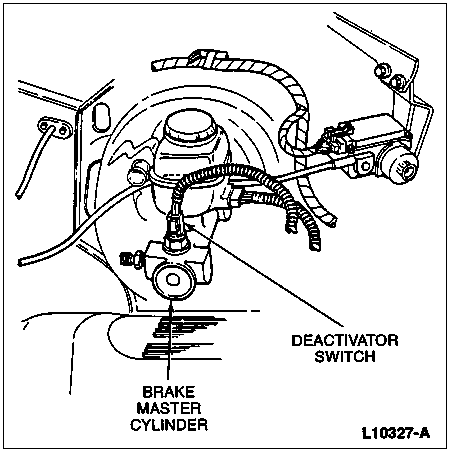
The deactivator switch is provided as an additional safety feature in the system. Normally, when the brake pedal (2455) is depressed, an electrical signal from the brake lamp circuit to the speed control amplifier (9D843) will turn off the system. Under increased brake pedal efforts (22-45 Nm [17-33 lb-ft]), the deactivator switch will open and remove power to the speed control actuator clutch, releasing the throttle independent of the speed control amplifier. The deactivator switch is located on the master cylinder on all vehicles except motorhome.
On motorhome chassis, deactivator switch is located on underside of brake master cylinder.
Programmable Speedometer/Odometer Module (PSOM)
All vehicles except motorhome are equipped with the programmable speedometer/odometer module (PSOM) and use the speed signal generated by the PSOM as the input signal to the speed control servo. On a motorhome, the speed signal is generated by a sensor located in the parking brake assembly.
System Activation
To operate the speed control system, the engine (6007) must be running and the vehicle speed must be greater than 48 km/h (30 mph). Under these conditions, the system is activated by pressing the ON switch in the steering wheel (3600). Then, the operator must press and release the SET/ACCEL switch. This will result in the current speed being maintained until a new speed is set, the brake pedal is pressed, the clutch pedal (7519) is pressed on manual transmission vehicles, or the OFF switch is pressed. Only one switch button should be pressed at a time because the speed control system will accept only one command at a time.
Increasing Set Speed
Accel
A continuous depression of the SET/ACCEL switch will cause a smooth increase in vehicle speed. Upon release of the SET/ACCEL switch, the new vehicle speed will be maintained.
The vehicle speed can be manually increased at any time by pressing the accelerator pedal and shaft (9725) until the higher speed is reached and stabilized, then pressing and releasing the SET/ACCEL switch.
Tap-Up
Current vehicle set speed may be increased 1.6 km/h (1 mph) by a momentary tap of the SET/ACCEL switch. Multiple taps of the SET/ACCEL switch will cause vehicle speed to increase in increments of 1.6 km/h (1 mph). For example, if currently set at 80 km (50 mph) then five taps will increase vehicle speed and set it at 88 km (55 mph).
Decreasing Set Speed
Coast
A continuous depression of the COAST switch will cause a smooth decrease in vehicle speed. Upon release of the COAST switch the new vehicle speed will be maintained.
The vehicle speed can be manually decreased at any time by momentarily pressing the brake pedal until the lower speed is reached and stabilized, then pressing and releasing the SET/ACCEL switch.
If vehicle speed is reduced below 48 km/h (30 mph) then the driver must manually increase the speed to over 48 km/h (30 mph) and reset the system.
Tap-Down
Current vehicle set speed may be decreased 1.6 km/h (1 mph) by a momentary tap of the COAST switch. Multiple taps of the COAST switch will cause vehicle speed to decrease in increments of 1.6 km/h (1 mph). For example, if currently set at 88 km (55 mph), then five taps will decrease vehicle speed and set it at 80 km (50 mph).
Resume
When the speed control system is disabled by pressing the brake pedal or clutch pedal if so equipped, the previous set speed may be re-established by momentarily pressing the RESUME switch. The RESUME feature will not function if the system has been turned off with the OFF switch or if the key is turned off. If the vehicle speed has dropped below 48 km/h (30 mph), then RESUME will not function until the vehicle speed becomes greater than 48 km/h (30 mph).
Contact Assembly (Clockspring)
The contact assembly provides electrical interface between the steering column tube (3514) and the control switches in the steering wheel.
Ground Brush
The speed control ground brush assembly provides an electrical ground path between the steering wheel and steering column tube.