1994 PCED OBDI-A | SECTION 20A: Diesel Diagnosis—7.3L IDI Engine |
Injection Nozzle Testing
Where ideal conditions of good combustion, specified engine temperature control and absolutely clean fuel prevail, nozzles require little attention. Nozzle trouble is usually indicated by one or more of the following symptoms:
- Smoky exhaust (black)
- Loss of power
- Misfiring
- Increased fuel consumption
- Combustion knock
- Engine overheating
When faulty nozzle operation is suspected on an engine that is misfiring or puffing black smoke, a simple test can be made to determine which cylinder(s) is causing the problem.
- Run the engine at the rpm which makes the problem most pronounced.
 WARNING: BE EXTREMELY CAREFUL TO PREVENT BEING STRUCK BY DIESEL FUEL UNDER PRESSURE. DIESEL FUEL AT INJECTION PRESSURE CAN EASILY PIERCE THE SKIN, POSSIBLY CAUSING SEVERE INJURY FROM BLOOD POISONING. IF STRUCK BY PRESSURIZED DIESEL FUEL, SEEK MEDICAL HELP IMMEDIATELY.
- Momentarily loosen the high-pressure fuel inlet line connection on one nozzle assembly one-half to one turn. Then, tighten connection to specification.
- Check each cylinder in the same manner.
- If one nozzle is found where loosening makes no difference in the misfiring, or the puffing black smoke stops, that nozzle should be tested. Test only the suspect nozzle(s).
Note: It is advisable to test the nozzles before cleaning them.
Remove suspect nozzles as outlined in Service Manual, Section 03-01D. After removing nozzle(s) from the engine, the Injection Nozzle Test should be performed. This test will provide valuable information regarding the condition of the nozzle(s). A clean workbench, clean washing fluid containers, clean tools and clean hands are all essential to produce satisfactory results.
Figure 33 shows the Rotunda Injection Nozzle Tester, 014-00300 or equivalent used for this test.

Figure 33: Injection Nozzle Tester 014-00300
Note: Perform this check only if engine has an obvious combustion knock or miss.
WARNING: ALWAYS WEAR APPROVED SAFETY GLASSES WHEN OPERATING THE TESTER. VOLATILE LIQUIDS CAN BE EXTREMELY FLAMMABLE WHEN VAPORIZED. AVOID ANY CONDITIONS (SPARKS, OPEN FLAMES, LIT CIGARETTES, ETC.) WHICH MIGHT IGNITE THE FLUID USED DURING THE TEST PROCEDURE. THE ONLY LIQUID APPROVED FOR USE IN THIS TESTER IS SAE CALIBRATION NO. 208629, OR EQUIVALENT CALIBRATION FLUID (SAE J968D OR ISO 4113).
WHEN A NOZZLE IS BEING TESTED OR IS IN OPERATION, KEEP HANDS AND OTHER PARTS OF THE BODY AWAY FROM THE NOZZLE. THE LIQUID DISCHARGE LEAVES THE NOZZLE TIP WITH SUFFICIENT FORCE TO PENETRATE THE SKIN AND CAUSE SERIOUS INJURY. THE NOZZLE TIP SHOULD BE ENCLOSED IN A TRANSPARENT RECEPTACLE IF AVAILABLE.
- Prepare stand for making tests. Fill stand reservoir with clean Calibration Fluid. Open tester valve slightly and operate tester handle to expel air from tester and outlet pipe. Operate tester until solid fluid (without air bubbles) flows from end of outlet pipe. Close tester valve.
- Connect injection nozzle to test stand. Care should be taken to avoid cross-threading. Tighten connector nut securely with end wrench. Nozzle Adapter which is supplied with tester 014-00300 has RH thread to nozzle assembly and LH thread to tester piping.
- Bleed air from nozzle. Open stand valve and operate tester handle for 8 to 10 quick strokes to expel (bleed) air from injection nozzle. Fluid should discharge from the spray hole in nozzle tip.
Note: Disregard tip leakage during this test.
Note: Spray pattern testing is not required.
- Check nozzle opening pressure. Close pump valve, and operate pump handle in slow even strokes to bring system up to pressure. Record highest pressure reached before nozzle opens. Repeat operation, increasing handle speed if necessary to establish consistent readings. Refer to Figures 34 and 35 for nozzle opening pressures.
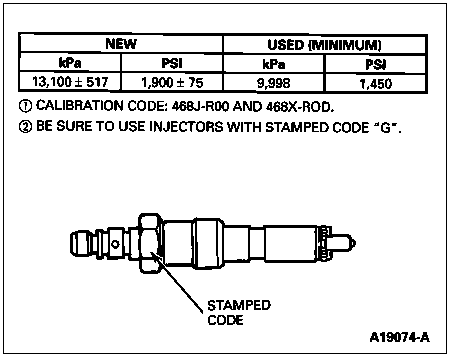
Figure 34: Nozzle Opening Pressure, 7.3L IDI Turbo Diesel Engine
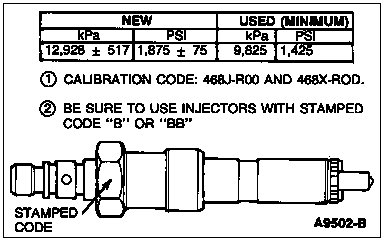
Figure 35: Nozzle Opening Pressure, 7.3L Naturally-Aspirated Diesel Engine
Note: Make sure that any accumulation at the nozzle tip is not due to test fluid leaking down the outside of the nozzle body from the return openings. If questionable, wrap a shop cloth around the nozzle body to prevent fluid leaking down the outside of the nozzle body from reaching the tip.
- Check for tip leakage. Blow nozzle tip dry using filtered compressed air. Operate test pump to maintain pressure at about 1378 kPa (200 psi) below the opening pressure obtained in Test 1. Wetting of the nozzle tip is acceptable as long as a drop does not fall within five seconds (Figure 36).
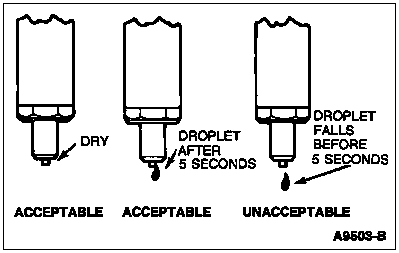
Figure 36: Nozzle Leakage Patterns
- After testing is completed, make sure to open the pump valve to release the built up pressure prior to removing the nozzle from the tester. When nozzle is removed, cap the nozzle tip and inlet until installed back in engine.
Note: If nozzle passes the nozzle opening pressure and tip leakage tests, it is suitable for further service in the engine.
Note: Nozzles showing leakage at nozzle tip spray hole or opening pressure below the minimum permissible limit, are damaged or worn and must be replaced, if within warranty coverage. Servicing the nozzle(s) (disassemble, clean and rebuild) instead of replacement to correct nozzle tip leakage or low opening pressure is only permissible beyond the warranty period if so desired.
Note: Warranty claims for replacement of the nozzle(s) will not be accepted unless the completed Engine Performance (Diagnostic) Chart is submitted with the returned part(s).