Section 00-00: Power Stroke Diesel Engine | 97-15A 7.3L DI Turbo Workshop Manual |
ELECTRONIC CONTROL SYSTEM DIAGNOSTICS |
Signal Functions
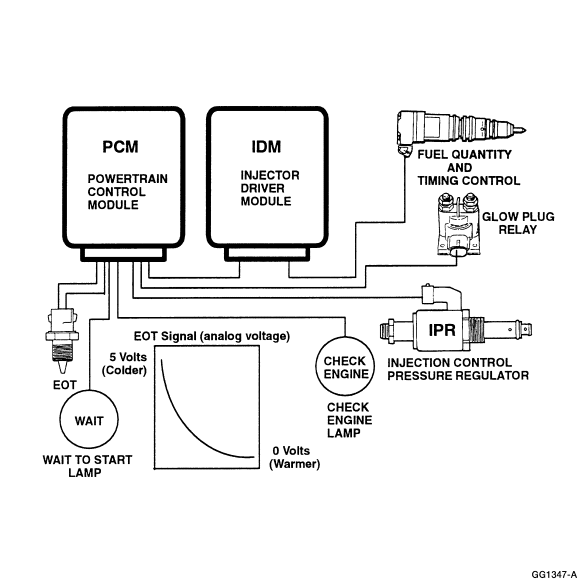
The Engine Oil Temperature (EOT) sensor is a thermistor type sensor that has a variable resistance which changes when exposed to different temperatures. When interfaced with PCM it produces a 0 to 5 volt analog signal that will measure engine oil temperature.
Cranking Fuel Quantity/Timing Control
The EOT signal is used to determine the timing and quantity of fuel required to optimize starting over all temperature conditions.
Temperatures Compensation
Fuel quantity and timing is controlled throughout the total operating range to compensate for oil viscosity changes due to temperature variations and insure that adequate torque and power is available.
Idle Speed (Vehicles with Automatic Transmission)
At oil temperatures below 32°F (0°C), low idle is incrementally increased to a maximum of 1200 RPM at - 20°F (-30°C).
Idle Speed (Vehicles with Manual Transmission)
At oil temperatures below 95°F (35°C), low idle is incrementally increased to a maximum of 1200 RPM at - 20°F (-30°C).
Fault Detection/Management
An EOT signal that is detected out of range high or low by the PCM will cause the PCM to ignore the EOT signal and default to a 212°F (100°C) value for engine oil temperature. The CHECK engine lamp will also be illuminated as long as the fault condition exists. The NGS tool will display a fixed PID value of 212°F (100°C) when EOT is in default.
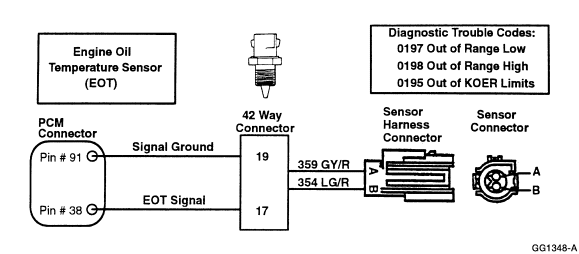
NOTE: After removing connector always check for damaged pins, corrosion, loose terminals etc.
| Test Points | Spec | Comments |
|---|---|---|
| A to Grd. | < 5 ohms | Resistance to chassis ground, check with key OFF, if > than 5 ohms the harness is open |
| B to Grd. | > 1000 ohms | Resistance less than 1000 ohms indicates a short to ground |
| Test Points | Spec. | Comments |
|---|---|---|
| B to Grd. | 4.8 - 5.0 v | Pull up voltage, if no or low voltage, circuit has open or high resistance or short to ground |
| A to Grd. | 0 - .25 v | If greater than .25 volts signal ground is open or shorted to VRef or battery. |
| Test Points | Spec | Comments |
|---|---|---|
| #91 to A | < 5 ohms | Resistance from harness connector to 104 pin connector - Signal ground |
| #38 to B | < 5 ohms | Resistance from harness connector to 104 pin connector - EOT Signal |
| Test Points (+) #38 to (-) #91 | Temp. °C | Resistance | Comments | |
|---|---|---|---|---|
| Voltage | Temp. °F | |||
| 0.53 v | 248 | 120 | 1.19 K ohms | |
| 0.96 v | 205 | 96 | 2 K ohms | |
| 1.37 v | 176 | 80 | 3.84 K ohms | |
| 4.37 v | 32 | 0 | 7.21 K ohms | |
| 4.60 v | -5 | -20 | 8.22 K ohms | |
| Circuit Faults: |
|---|
| 0197 = Signal was less than .04 volts for more than 0.2 seconds. |
| 0198 = Signal voltage was greater than 4.9 volts for more than 0.2 seconds. |
| 0195 = Engine oil temperature less than 158° F (70° C) during KOER test (Access denied) or engine oil temperature greater than 242° F (117° C) during KOER test (aborts Test). |