Section 00-00: Power Stroke Diesel Engine | 97-15A 7.3L DI Turbo Workshop Manual |
OBD II GLOW PLUG DIAGNOSTICS (CALIFORNIA) |
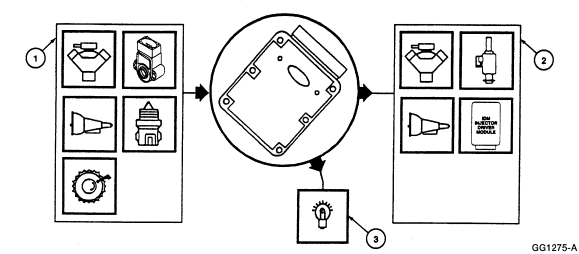
Figure 204: Comprehensive Component Monitor
Glow Plug Monitor
California and all Econoline vehicles utilize a Glow Plug Monitor (GPM) system designed to locate failed glow plugs or failed wiring in the glow plug system. Diagnostic Trouble Codes (DTCs) indicate which bank has failed glow plugs or failed glow plug wiring.
Glow Plug Operation and Concern Diagnosis Explained
Econoline and California F-Series 7.3L DI: Useful information on troubleshooting fault codes on the glow plug monitoring system. The glow plug system is monitored when the glow plugs are commanded "ON" for over 30 seconds and battery voltage reads between 11.8V and 14V. You can monitor glow plug amps by using the NGS PIDS GPCTM, GPMR and GPML. DTC P1395 or P1396 will set either on the bank that is reading less than 32 amps or the bank that is reading at least 8-1/2 amps lower than the other bank. Loose or fitting pins on the circuit connectors causing high resistance or high resistance glow plug(s) on the opposite bank could also be the cause. Each bank should draw more than 32 amps with not more than 8-1/2 amps difference between banks. DTC P1391 or P1393 will set when the monitor indicates that all four (4) glow plugs are not being powered on that bank.
Possible Causes:
Open glow plug circuits, glow plug relay, glow plugs or monitoring circuits(s).
Both DTCs P1391 and P1393 together will set when the monitor indicates that all eight (8) glow plugs are not being powered.
Possible Causes:
Open in all glow plug circuits, glow plugs, glow plug relay, fusible links or all three (3) monitoring circuits. If KOEO on demand DTC P0380 is also set, a problem on the glow plug relay triggering circuit will cause all three (3) DTCs to set.
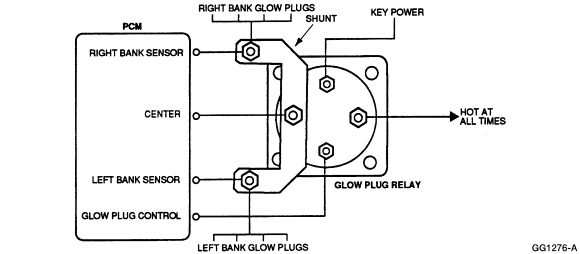
The GPM system uses two low resistance shunts. One shunt conducts the current to the glow plugs in the left cylinder head and the other shunt conducts the current for the right cylinder head. Three sensing wires measure the voltage drops across the shunts when the glow plugs are operating (the voltage drops are proportional to the current in the shunt). The voltage drops are measured after the glow plug current stabilizes (approximately 30 seconds). Therefore, this system only checks for glow plug operation when oil temperature and/or altitude conditions cause the glow plugs to stay on for 30 seconds or more and system voltage is between 11.8 and 14.0 volts.
A menu pick on the NGS tester KOER Glow Plug Monitor Test allows 30 second operation of the GPM system independent of oil temperature or altitude.
The GPM also checks the added sensing wires for out of range readings. These checks indicate a shorted or open sensing wire, or a glow plug relay failure by setting DTCs. The DTCs are stored in continuous memory when a fault is determined, and the Malfunction Indicator Lamp (MIL) is illuminated on the second drive cycle if an OBD II fault is detected. The 49 state Econoline vehicles use the GPM system and hardware to detect faults but do not illuminate the MIL.
The glow plug relay coil is checked for opens or shorts as part of Comprehensive Component Monitoring.
The following is an example of some of the input and output components monitored by the GP monitor. The components monitored belong to the engine system.
Inputs:
Outputs:
The MIL is activated after a fault is detected on two consecutive drive cycles, if the fault detected affects emissions.
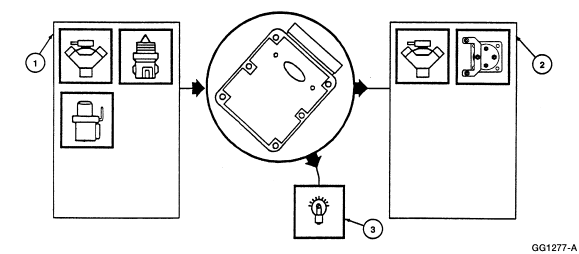
Figure 205: Glow Plug Monitor