Section 06-02: Brakes, Rear Drum | 1997 F-250 Heavy Duty and F-350 4x2 and 4x4 Vehicles Workshop Manual |
ADJUSTMENTS
Brake Shoe and Lining
 WARNING: DO NOT INHALE DUST FROM BRAKES OR ASSOCIATED COMPONENTS. INHALATION OF DUST CAN BE HAZARDOUS TO YOUR HEALTH AND CAN CAUSE CANCER OR ASBESTOSIS. COMPRESSED AIR OR BRUSHES MUST NOT BE USED TO CLEAN BRAKES, BRAKE DRUMS (1126) AND ASSOCIATED COMPONENTS. A VACUUM CLEANER SUCH AS ROTUNDA BRAKE/CLUTCH/VACUUM 164-R3600 OR EQUIVALENT EQUIPPED FOR THIS PURPOSE SHOULD BE CAREFULLY USED TO REMOVE DUST. ADHERENT DUST MUST BE REMOVED WITH A DAMP RAG. DUST MUST BE CONTAINED IN A SEALED AND LABELED BAG FOR DISPOSAL. WEAR AN APPROVED HIGH EFFICIENCY CARTRIDGE OR AIR LINE RESPIRATOR AND USE EXTRA CAUTION TO AVOID BREATHING DUST.
After adjusting the rear brake shoes and linings (2200), check the brake shoe adjusting lever cables (2A178) for proper adjustment. Make sure the parking brake cable equalizer (2A602) operates freely. Refer to Section 06-05 for additional information.
Drums Removed
With brake drums removed, use Rotunda Brake/Clutch/Service Vacuum 164-R3600 or equivalent to remove any dust present on the brake assembly.
Carefully remove the brake shoe retracting springs (2296). Using sandpaper, clean the shoe-to-backing plate contact points while holding the rear brake shoe and lining away from the brake backing plate (2211).
Check brake backing plate for damage. If any damage is found, it must be replaced. Refer to Brake Backing Plate in the Removal and Installation portion of this section. If no damage is found, apply a small amount (0.80 mm [1/32 inch] thick) of Silicone Brake Caliper Grease and Dielectric Compound D7AZ-19A331-A (Motorcraft WA-10) or equivalent meeting Ford Specification ESE-M1C171-A to the ledges where the rear brake shoes and linings touch the brake backing plate. Be careful not to get the lubricant on the linings. Also lubricate the adjusting cable eye and the anchor pin area.
Reinstall brake shoe retracting springs.
Use Rotunda Brake Shoe Setting Gauge 104-00063 or equivalent to adjust the brake linings to the inside diameter of the drum braking surface.
Measuring Brake Drum
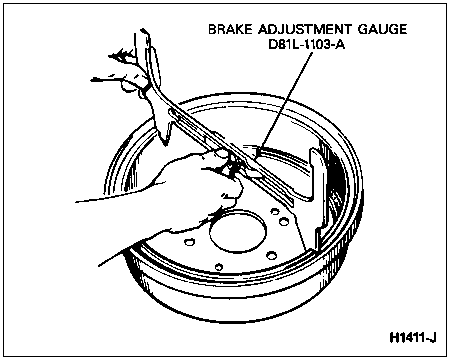
Reverse the tool and adjust the rear brake shoes and linings until they touch the gauge. The gauge contact points on the rear brake shoes and linings must be parallel to the vehicle with the centerline through the center of the axle.
Measuring Rear Brake Shoe and Lining
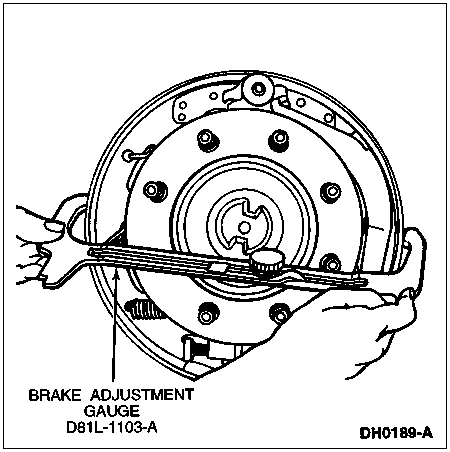
Hold the brake shoe adjusting lever (2A176) out of engagement while rotating the adjusting screw (part of brake adjuster screw (2041)) to prevent burring the screw slots. Make sure the adjusting screw rotates freely.
If necessary, remove brake shoe adjusting lever from the brake assembly. Disassemble and clean the brake shoe adjusting lever. Lubricate the adjusting screw threads with a thin, uniform coating of Silicone Brake Caliper Grease and Dielectric Compound D7AZ-19A331-A (Motorcraft WA-10) or equivalent meeting Ford Specification ESE-M1C171-A.
Install the brake drums.
Install the wheels (1007) on the hubs or axle shaft flanges against the brake drums and tighten the wheel mounting nuts to specification listed in the Wheel Torque Specifications chart at the end of this section.
Complete the adjustment by applying the brakes sharply several times while driving the vehicle in reverse.
After adjusting the rear brake shoes and linings, check brake operation by making several stops while driving forward.
Drums Installed
Raise the vehicle until the tires clear the floor. Install safety stands under the axle.
Remove the brake adjusting hole cover (2092) at the bottom of the brake backing plate, and turn the brake adjuster screw (inside the hole) to expand the rear brake shoes and linings until they drag against the brake drum as shown.
Expanding Brake Shoes
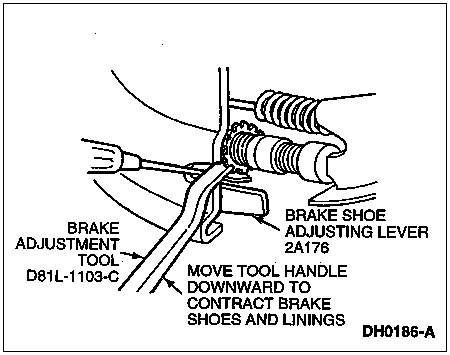
When the rear brake shoes and linings are against the brake drum, loosen the brake adjuster screw so the brake drum rotates freely without drag. If the brake drum does not rotate freely, remove the wheel and brake drum.
Using Rotunda Brake/Clutch/Service Vacuum 164-R3600 or equivalent, vacuum out any dust and dirt from the linings.
Remove brake shoe hold-down springs (2068).
Using sandpaper, remove any rust from the points where the rear brake shoes and linings touch the brake backing plate while holding rear brake shoes and linings away from brake backing plate.
Apply a light coating of Silicone Brake Caliper Grease and Dielectric Compound D7AZ-19A331-A (Motorcraft WA-10) or equivalent meeting Ford Specification ESE-M1C171-A to the contact areas of the brake backing plate. Do not get the lubricant on the linings.
Install brake shoe hold-down springs. Install the wheel and brake drum, and adjust the rear brake shoes and linings.
Install the brake adjusting hole cover on the brake backing plate.
Check and adjust the other brake assembly.
WARNING: PERFORM THE ROAD TEST ONLY WHEN THE BRAKES WILL APPLY AND THE VEHICLE CAN BE STOPPED SAFELY.
Apply the brakes. If the brake pedal (2455) travels more than half-way to the floor, there is too much clearance between the rear brake shoes and linings and the brake drums. Repeat Steps 2 and 3 above.
When all rear brake shoes and linings have been adjusted properly, lower the vehicle and road test to check brake operation.