1994 PCED OBDI-A | SECTION 6A: EEC-IV Pinpoint Test
Procedures |
TD1 KEY ON ENGINE OFF DIAGNOSTIC TROUBLE CODES (DTCS) 67/634, 522 AND 654:
CHECK MANUAL LEVER POSITION (MLP) SENSOR ALIGNMENT
DTCs 67 and 634 indicate the MLP sensor is out of Self-Test range when the gear selector is in PARK.
DTCs 522 and 654 indicate the gear selector was not in Park during Self-Test.
Possible causes:
- Misadjusted linkage.
- Open or short in harness circuits.
- Damaged MLP sensor.
- Damaged PCM.
- Key off.
- Apply parking brake.
- Place transmission in NEUTRAL.
- Verify that Manual Lever Position (MLP) Sensor Tool (Rotunda T91P-7010-AHT) or equivalent fits in the appropriate slot.
Does the tool fit properly?
| Yes | No |
|---|
| REMOVE tool. GO to TD2. | PLACE the transmission in NEUTRAL. LOOSEN the two MLP sensor mounting bolts. MOVE the sensor to allow insertion of the Transmission Range Sensor Tool in the appropriate slots. TIGHTEN the two mounting bolts to specification. REMOVE tool. VERIFY shift linkage adjustment. CLEAR Continuous Memory (REFER to Quick Test Appendix, Section 5A). RERUN Quick Test. |
TD2 CHECK CONTINUITY OF MLP SENSOR HARNESS CIRCUITS
- Key off.
- Disconnect Powertrain Control Module (PCM). Inspect for damaged or pushed out pins, corrosion, loose wires, etc. Service as necessary.
- Disconnect MLP sensor.
- Using a mirror, inspect both ends of transmission harness connector at MLP sensor for damaged or pushed out pins, corrosion, loose wires, etc. Service as necessary.
- Install breakout box, leave PCM disconnected.
- Measure resistance between Test Pin 30 at the breakout box and MLP signal circuit at the MLP sensor vehicle harness connector.
- Measure resistance between Test Pin 46 at the breakout box and SIG RTN circuit at the MLP sensor vehicle harness connector.
Is each resistance less than 5.0 ohms?
| Yes | No |
|---|
| GO to TD3. | SERVICE open circuit(s). REMOVE breakout box. RECONNECT all components. RERUN Quick Test. |
TD3 CHECK TR CIRCUIT FOR SHORT TO POWER AND GROUND
- Key off.
- MLP sensor disconnected.
- Breakout box installed, PCM disconnected.
- Measure resistance between Test Pin 30 and Test Pins 37/57, 40/60 and 46 at the breakout box.
- Measure resistance between Test Pin 30 at the breakout box and chassis ground.
Is each resistance greater than 10,000 ohms?
| Yes | No |
|---|
| GO to TD4. | SERVICE short circuit(s). REMOVE breakout box. RECONNECT all components. RERUN Self Test. |
TD4 CHECK TR SENSOR RESISTANCE
- Key off.
- Connect MLP sensor.
- Breakout box installed, PCM disconnected.
- Unlock steering column.
- Measure resistance between Test Pin 30 and Test Pin 46 at the breakout box in each gear selector position. Refer to the MLP sensor resistance specification table.
Is each resistance within specification?
| Yes | No |
|---|
| REPLACE PCM. REMOVE breakout box. RERUN Self Test. | REPLACE MLP sensor. REMOVE breakout box. RERUN Self Test. |
TD9 TRANSMISSION REMAINS IN 3RD GEAR ONLY WITH SELECTOR IN "D" AND "OD"
PRELIMINARY CHECKS
- Check transmission fluid level and fluid condition. Service as necessary.
- Test drive vehicle to check/verify symptom. During the test drive:
- Drive vehicle with gear selector in both DRIVE (D) and OVERDRIVE (OD) positions. Check to see if symptom can be consistently reproduced, or if it is an intermittent concern.
Can the symptom be consistently reproduced?
| Yes | No |
|---|
| GO to TD11. | GO to TD20 (intermittent concern). |
TD10 DIAGNOSTIC TROUBLE CODE (DTC) 634:
CHECK SYMPTOM
Continuous Memory DTC 634 indicates that the PCM has detected an invalid combination of transmission range switch states.
Note: Park/Neutral Position (PNP) switch is considered a transmission range switch in this Pinpoint Test.
- Test drive vehicle with gear selector in both DRIVE (D) and OVERDRIVE (OD) positions. Check to see if transmission is always in 3rd gear with selector in the D or OD position.
With the gear selector in D and OD position, is transmission ALWAYS in 3rd gear?
| Yes | No |
|---|
| GO to TD11. | If symptom is "Transmission stays in 3rd gear occasionally," GO to TD20. For all other symptoms, DISREGARD Continuous DTC 634. CLEAR Continuous Memory. RETURN to Section 2A to address symptom/other DTCs as necessary. |
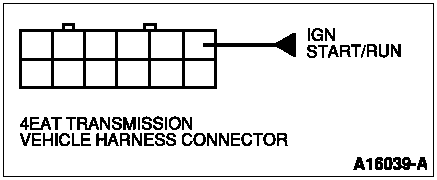
TD11 CHECK FOR IGN START/RUN CIRCUIT VOLTAGE AT TRANSMISSION
- Key off.
- Disconnect 4EAT transmission connector (12-pin at transmission).
- Key on.
- Measure voltage between IGN START/RUN circuit at transmission vehicle harness connector and chassis ground.
Is voltage greater than 10.5 volts?
| Yes | No |
|---|
| Key off. GO to TD12. | SERVICE open circuit (verify condition of related fuse). RECONNECT transmission connector. RERUN Quick Test. RE-EVALUATE symptom. |
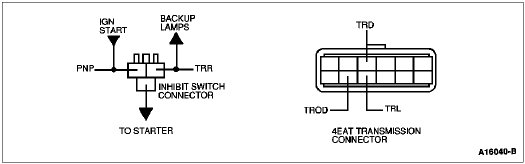
TD12 CHECK FUNCTION OF THE TRANSMISSION RANGE SWITCHES
- Key off.
- Transmission 12-pin connector disconnected.
- Disconnect inhibit (PNP) switch (3-pin at transmission).
- Refer to Transmission Range Switch State chart at the beginning of this Pinpoint Test. Verify that each Transmission Range switch state is correct for each gear selector position. (Open is defined as greater than 10,000 ohms. Closed is defined as less than 5.0 ohms.)
- Shift lever to PARK.
Do the Transmission Range switches check out OK?
TD13 CHECK TRANSMISSION SWITCH INPUT VOLTAGES AT BREAKOUT BOX
- Key off.
- Disconnect Powertrain Control Module (PCM). Inspect for damaged or pushed out pins, corrosion, loose wires, etc. Service as necessary.
- Install breakout box or 4EAT Tester, leave PCM disconnected.
- Reconnect transmission 12-pin connector and inhibit switch.
- Key on, engine off.
- Refer to Transmission Range Switch Voltage at breakout box chart at the beginning of this Pinpoint Test. Verify that each Transmission Range switch voltage is correct for each gear selector position (read voltages with the key on, engine off and PCM disconnected).
- Shift lever to PARK.
Do Transmission Range Switch voltages check out OK?
| Yes | No |
|---|
| GO to the Transmission Group in the Service Manual to check all other possible causes of the symptom. Also GO to Section 2A to check all other possible causes. If all checks are OK, REPLACE PCM. | SERVICE faulty circuit.
—For circuit voltage always low (less than 0.5 volt) (except PNP Pin 30):
SERVICE open circuit.—For circuit voltage always greater than 10.5 volts:
SERVICE short to power. —For circuit voltage that "mirrors" that of another circuit:
SERVICE shorted circuits.
REMOVE breakout box. RECONNECT PCM.
RERUN Quick Test. RE-EVALUATE symptom. |
TD14 CHECK ADJUSTMENT/EXTERNAL WIRING OF THE MANUAL LEVER POSITION SWITCH
- Key off.
- Check transmission connectors, external wiring for open or shorts. Service as necessary.
- Check adjustment of manual lever position switch. Refer to Transmission Group in the Service Manual (Park/Neutral Position (PNP) Switch section).
Are the above checks OK?
| Yes | No |
|---|
REPLACE Manual Lever Position switch. RECONNECT all components.
RERUN Quick Test. RE-EVALUATE symptom. | SERVICE as necessary. RECONNECT all components.
RERUN Quick Test. RE-EVALUATE symptom. |
TD20 VISUALLY CHECK EEC-IV HARNESS BETWEEN EEC-IV AND TRANSMISSION
- Visually check Transmission Range switch and shift solenoid wires between Powertrain Control Module and transmission.
Do Transmission Range switch and shift solenoid wires appear OK?
| Yes | No |
|---|
| GO to TD21. | SERVICE as necessary. RE-EVALUATE symptom. |
TD21 CHECK HARNESS AND CONNECTORS FOR INTERMITTENT OPENS OR SHORTS
Note: This Pinpoint Test Step is included to help isolate a possible intermittent Transmission Range switch circuit concern.
- Key off.
- Disconnect Powertrain Control Module (PCM). Inspect for damaged or pushed out pins, corrosion, loose wires, etc. Service as necessary.
- Install breakout box or 4EAT tester. Leave PCM disconnected.
- Key on.
- Refer to the "4EAT Transmission Range Switch Voltage at EEC-IV Breakout Box" chart at the start of this Pinpoint Test. Connect a test lamp between Test Pin 23 (TRR) and Test Pin 40 (GND). Observe test lamp for an indication of a fault while performing the following (the light will be normally on when the gear selector is in the same position as the circuit being tested (i.e., TRR=Reverse), and off in all other selector positions.
A fault will be indicated by the light going off when it should be on (open in Transmission Range switch circuit or IGN START/RUN circuit), or on when it should be off (short to power).
- Shake, wiggle, bend the Transmission Range switch circuit between the PCM and the transmission.
- Shake, wiggle, bend the IGN START/RUN circuit.
- Lightly tap on the Inhibit Switch to simulate road shock.
- After completing testing on the TRR circuit, repeat the testing for the other Transmission Range Switch circuits (TRL, TRD, TROD).
- Key off.
Is a fault indicated?
| Yes | No |
|---|
| ISOLATE fault and SERVICE as necessary. REMOVE breakout box. RECONNECT all components. RE-EVALUATE symptom. | RETURN to Section 2A to address this or any other symptom. |
TD22 ROAD TEST (ESCORT/TRACER ONLY)
The purpose of the road test is to identify an area of concern by monitoring certain controlled parameters while trying to recreate a driveability or MIL symptom.
Note: A basic working knowledge of the EEC-IV system is critical to effectively analyze road test data.
 WARNING: THIS ROAD TEST IS A SUGGESTED BUT OPTIONAL PROCEDURE. ALL APPLICABLE SAFETY PROCEDURES AND TRAFFIC LAWS MUST BE FOLLOWED. IN ORDER FOR A ROAD TEST TO BE PERFORMED, IT IS REQUIRED THAT ANOTHER PERSON ACCOMPANY THE DRIVER. THE ACCOMPANYING PERSON CAN MAKE MEASUREMENTS, OBSERVE CHANGES AND RECORD NOTES. IF FOR SOME REASON THIS TEST IS NOT PERFORMED, RETURN TO SECTION 2A FOR OTHER POSSIBLE CAUSES.
Prepare Vehicle For a Road Test
- Disconnect Powertrain Control Module (PCM). Inspect for damaged or pushed out pins, corrosion, loose wires, etc. Service as necessary.
- Install breakout box/4EAT tester and connect PCM to breakout box/4EAT tester.
- Other materials needed: DVOM, pencil, paper, appropriate schematic/pin usage sheet (from Section 3A or Section 4A).
- Optional equipment:
- Fuel pressure gauge, manifold vacuum gauge, MAP/BARO tester.
- Preliminary Power/Ground Checks
- With the key ON and a DVOM referenced to the battery negative post, check the following signals for correct values.
- POWERS: KAPWR > 10.5V (Pin 1), VPWR > 10.5V (Pins 37/57), VREF 5 ± 1V (Pin 26).
GROUNDS: (all = 0 ± .5V): PWR GND (Pins 40/60), SIG RTN (Pin 46), IGN GND (Pin 16).
OPTIONAL GROUNDS: HO2S GND (Pin 49) CSE GND (Pin 20) MAF RTN (Pin 9 or 15). - Obtaining Other Information and Materials Before the Road Test
- Refer to the Transmission Range Switch Voltage at EEC-IV breakout box chart at the beginning of this Pinpoint Test. These are the main signals that will be monitored. The PNP input (Pin 30) should also be monitored (with the PNP switch referenced to GND, the voltage should be about zero volts in Park or Neutral and greater than 3.0 volts in all other gearshift positions).
- Refer to the Symptom Charts in Section 7A, EEC-IV Monitor Box: Intermittent Fault Diagnosis that most resemble the driveability or MIL symptom. Before the road test, perform the Visual/Mechanical Checks that are listed. Next, list the EEC-IV sensors and actuators in the order given. These are the main signals that will be monitored.
- Refer to the proper Diagnostic Reference Value Sheet in Section 7A, Appendix. Although these charts were designed for use with the EEC-IV Monitor Box, most of the values can be read using the breakout box and a DVOM (with the DVOM referenced to ground, all values in DCV units can be used; other values may also be helpful, ex., MAP Hz using the MAP/BARO tester). Also refer to Section 7A, Appendix: EEC-IV Graphs and Charts.
- After starting the engine for the road test, enter Engine Running Continuous Monitor Diagnostic Test Mode (refer to Quick Test Appendix, Section 5A).
- Drive the vehicle to create the conditions in which the symptom will occurs. If the Customer Information Worksheet from Section 2A has been completed, this information may help in recreating the symptom.
- When the symptom occurs, the passenger should observe changes in listed EEC-IV signals. Information about the symptom, operating condition, value of the EEC-IV signal or other notes should be recorded.
- If the symptom cannot be duplicated, verify that the EEC-IV values are in the expected range.
- Analyzing the Data
- Once the road test is completed, the results should be analyzed to locate and service the fault which caused the symptom.
- If no problem is identified, return to Section 2A for other possible causes of the symptom.
 TD: Introduction