1994 PCED OBDI-A | SECTION 6A: EEC-IV Pinpoint Test
Procedures |
J1 DIAGNOSTIC TROUBLE CODE (DTC) 556:
CHECK FOR VPWR TO FUEL PUMP RELAY
Is voltage greater than 10.5 volts?
| Yes | No |
|---|
| GO to J2. | VERIFY integrity of IFS switch. If OK, SERVICE open in VPWR circuit between the EEC power relay and the fuel pump relay. RECONNECT fuel pump relay. RERUN Quick Test. |
J2 CHECK FUEL PUMP RELAY
- Key off.
- Fuel pump relay disconnected.
- DVOM on 200 ohm scale.
- Check fuel pump relay coil resistance:
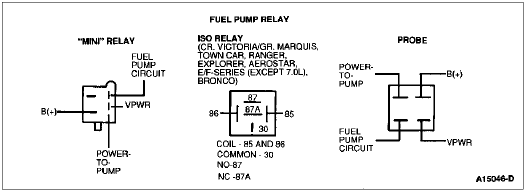
- For "ISO" relays, measure resistance between Pins 85 and 86 at the fuel pump relay (pin numbers molded on relay).
- For other types of relays, measure resistance between VPWR pin and fuel pump circuit pin at the fuel pump relay.
- Resistance should be between 40 and 85 ohms.
- DVOM on 10,000 ohm scale.
- Check fuel pump relay for internal shorts.
- For "ISO" relays, measure resistance between Pin 85 and both Pins 30 and 87 at the fuel pump relay.
- For other types of relays, measure resistance between the fuel pump circuit pin and both the power-to-pump and B(+) pins at the fuel pump relay.
- Both resistances should be greater than 10,000 ohms.
Are all resistance checks OK?
J3 CHECK FUEL PUMP CIRCUIT FOR SHORT TO POWER
- Key off.
- Fuel pump relay disconnected.
- Disconnect Powertrain Control Module (PCM). Inspect for damaged or pushed out pins, corrosion, loose wires, etc. Service as necessary.
- Install breakout box, leave PCM disconnected.
- Key on, engine off.
- Measure voltage between Test Pin 22 at the breakout box and battery negative post.
Is voltage less than 1.0 volt?
| Yes | No |
|---|
| GO to J4. | SERVICE short circuit. REMOVE breakout box. RECONNECT all components. ATTEMPT to start vehicle. If vehicle fails to start, REPLACE PCM. RERUN Quick Test. |
J4 CHECK FUEL PUMP CIRCUIT FOR SHORT TO GROUND
- Key off.
- Breakout box installed, PCM disconnected.
- Fuel pump relay disconnected.
- Measure resistance between Test Pin 22 and Test Pins 40 and 60 at the breakout box.
Is resistance greater than 10,000 ohms?
| Yes | No |
|---|
| GO to J5. | SERVICE short circuit. REMOVE breakout box. RECONNECT all components. RERUN Quick Test. |
J5 CHECK FUEL PUMP CIRCUIT CONTINUITY
- Key off.
- Breakout box installed, PCM disconnected.
- Fuel pump relay disconnected.
- Measure resistance between fuel pump circuit at the fuel pump relay vehicle harness connector and Test Pin 22 at the breakout box.
Is resistance less than 5.0 ohms?
| Yes | No |
|---|
| REPLACE PCM. RECONNECT fuel pump relay. RERUN Quick Test. | SERVICE open circuit. REMOVE breakout box. RECONNECT all components. RERUN Quick Test. |
J10 DIAGNOSTIC TROUBLE CODE (DTC) 542:
DOES ENGINE START?
Does the engine start (for trucks with dual fuel tanks, verify tank selector is in the same position it was when KOEO DTC 542 was received)?
J11 VERIFY THAT FUEL PUMP IS OFF
- Key on, wait five seconds.
- Listen for motor noise from fuel pump (it may be necessary to listen by fuel tank).
Is fuel pump off?
J12 CHECK FOR FUEL PUMP RELAY
ALWAYS CLOSED
- Key off.
- Locate and disconnect fuel pump relay.
- Key on.
Is fuel pump off with relay disconnected?
| Yes | No |
|---|
| REPLACE fuel pump relay. RERUN Quick Test. | SERVICE short to power in power-to-pump/FPM circuit. (For applications with Relay Block, also CHECK fuel pump prime plug circuit (if equipped). REFER to schematic). RECONNECT fuel pump relay. RERUN Quick Test. |
J13 CHECK FPM CIRCUIT CONTINUITY
- Key off.
- Disconnect Powertrain Control Module (PCM). Inspect for damaged or pushed out pins, corrosion, loose wires, etc. Service as necessary.
- Install breakout box, leave PCM disconnected.
- Disconnect fuel pump relay.
- Measure resistance between Test Pin 8 (Test Pin 19 for Escort/Tracer) at the breakout box and power-to-pump circuit at the fuel pump relay vehicle harness connector.
Is resistance less than 5.0 ohms?
| Yes | No |
|---|
For dual HO2S applications:
RECONNECT fuel pump relay. GO to J25.All others:
REPLACE PCM. REMOVE breakout box. RECONNECT fuel pump relay. RERUN Quick Test. | SERVICE open circuit. REMOVE breakout box. RECONNECT all components. RERUN Quick Test. |
J15 CHECK INERTIA FUEL SHUTOFF (IFS) SWITCH
- Key off.
- Locate and disconnect Inertia Fuel Shutoff (IFS) switch (verify that switch is reset).
- Measure resistance between the C and NC pins of the IFS switch. (For Escort/Tracer and Probe, measure between GND pin and FP pin).
Is resistance less than 5.0 ohms?

| Yes | No |
|---|
| RECONNECT IFS switch. REFER to Fuel/Engine Group in Service Manual, (Electric Fuel Pump) for open in power-to-pump circuit, poor fuel pump ground, open in fuel pump, etc. | REPLACE or RESET IFS switch. RERUN Quick Test. |
J20 DIAGNOSTIC TROUBLE CODE (DTC) 543: DOES ENGINE START?
DTC 543 indicates a fuel pump secondary circuit failure between the B(+) supply and the FPM connection to the power-to-pump circuit.
Possible causes:
No Start:
- Open circuit between the B(+) supply and the FPM connection to the power-to-pump circuit.
- Fuel pump relay contacts always open.
Engine Starts:
- HO2S short to power (dual HO2S applications).
- Damaged Powertrain Control Module (PCM).
Does the engine start?
| Yes | No |
|---|
For dual HO2S applications:
GO to J25.All others:
REPLACE PCM. RERUN Quick Test. | GO to J21. |
J21 CHECK FOR B(+) TO FUEL PUMP RELAY
- Key off.
- Disconnect fuel pump relay.
- Measure voltage between B(+) circuit at the fuel pump relay vehicle harness connector and battery negative post.
Is voltage greater than 10.5 volts?
| Yes | No |
|---|
| GO to J22. | VERIFY integrity of fuse/fuse link for B(+) supply to fuel pump relay. If OK, SERVICE open in B(+) circuit. RECONNECT fuel pump relay. RERUN Quick Test. |
J22 CHECK POWER-TO-PUMP CIRCUIT CONTINUITY
- Key off.
- Fuel pump relay disconnected.
- Measure resistance between power-to-pump circuit at the fuel pump relay vehicle harness connector and the battery negative post.
Is resistance less than 10.0 ohms?
| Yes | No |
|---|
| REPLACE fuel pump relay. RERUN Quick Test. | SERVICE open in power-to-pump circuit between FPM splice and fuel pump relay. REFER to schematic. RECONNECT fuel pump relay. RERUN Quick Test. |
J25 CHECK LEFT/FRONT HEATED OXYGEN SENSOR (HO2S) FOR SHORT TO POWER
Note: Due to the internal circuitry of the PCM, a left/front HO2S signal short to power could produce a DTC 542 or 543.
- Key off.
- Disconnect left or front HO2S sensor.
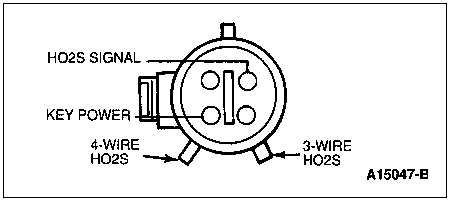
- Measure resistance between HO2S signal pin and KEY POWER pin at the HO2S sensor connector.
Is resistance greater than 10,000 ohms?
| Yes | No |
|---|
| GO to J26. | REPLACE HO2S. RERUN Quick Test. CLEAR Keep Alive Memory (REFER to Quick Test Appendix, Section 5A). |
J26 CHECK HO2S CIRCUIT FOR SHORT TO POWER
- Key off.
- Left or front HO2S disconnected.
- Disconnect Powertrain Control Module (PCM). Inspect for damaged or pushed out pins, corrosion, loose wires, etc. Service as necessary. Leave PCM disconnected.
- Key on.
- Measure voltage between the HO2S signal at the HO2S vehicle harness connector and chassis ground.
Is voltage less than 2.0 volts?
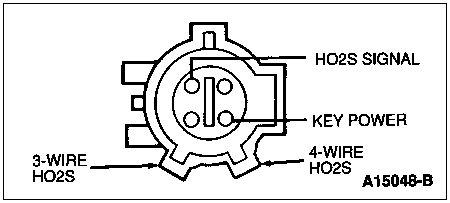
- HO2S Vehicle Harness Connector
| Yes | No |
|---|
| REPLACE PCM. RECONNECT HO2S. RERUN Quick Test. | SERVICE short circuit. RECONNECT PCM and HO2S. RERUN Quick Test. CLEAR Keep Alive Memory (REFER to Quick Test Appendix, Section 5A). |
J90 CONTINUOUS MEMORY DIAGNOSTIC TROUBLE CODE (DTC) 542: CHECK EEC-IV HARNESS
A Continuous Memory DTC 542 indicates that one of the following intermittent conditions has occurred:
- Fuel pump circuit activated when PCM expected circuit to be off (i.e., fuel system test or prime procedure).
- Inertia fuel shutoff switch reset (if in power-to-pump circuit).
- Open circuit in or between the fuel pump and FPM circuit at the PCM (refer to schematic).
- Poor fuel pump ground.
- FPM or power-to-pump circuit short to power.
- Fuel pump relay contacts stuck closed.
- Left/Front HO2S circuit short to power (with/dual HO2S).
- Engine stall due to excessive load.
Note: For trucks with dual fuel tanks, perform Key On Engine Off (KOEO) Self-Test twice, once with the front tank selected and once with the rear tank selected. If KOEO DTC 111 and Continuous DTC 542 is present both times, continue with this test (intermittent concern).
If KOEO DTC 542 is present in only one test, refer to the Fuel/Engine Group of the Service Manual to check for open circuit between select switch and suspect pump circuit ground.
- Start engine.
- Check for engine stall/stumble while performing the following (also, if possible, listen for fuel pump turning off).
- Shake, wiggle, bend the power-to-pump circuit between the power-to-pump pin at the fuel pump relay and the fuel pump.
- Shake, wiggle, bend the fuel pump ground circuit from the fuel pump to ground.
- Lightly tap the fuel pump to simulate road shock.
- For vehicles with the Inertia Fuel Shutoff switch in the power-to-pump circuit (refer to schematic), lightly tap Inertia Fuel Shutoff switch to simulate road shock.
- Key off.
- Inspect the fuel pump vehicle harness connector and the fuel pump ground for corrosion, damaged pins, etc.
Is fault indicated/found?
| Yes | No |
|---|
| ISOLATE fault and SERVICE as necessary. CLEAR Continuous Memory DTC (REFER to Quick Test Appendix, Section 5A). RERUN Quick Test. | GO to J91. |
J91 CHECK FPM CIRCUIT
- Key off.
- Disconnect PCM. Inspect for damaged or pushed out pins, corrosion, loose wires, etc. Service as necessary.
- Install breakout box, leave PCM disconnected.
- Key on, engine off.
- Connect a test lamp between Test Pin 8 (Test Pin 19 for Escort/Tracer) and Test Pin 37 at the breakout box.
- Observe test lamp for an indication of a fault while performing the following: (The light will go out when a fault is found indicating an open)
- Shake, wiggle, bend the Fuel Pump Monitor circuit between the fuel pump relay (or splice if applicable, refer to schematic) and the PCM.
Is fault indicated?
| Yes | No |
|---|
| ISOLATE fault and SERVICE as necessary. REMOVE breakout box. RECONNECT PCM. RERUN Quick Test. | GO to J92. |
J92 CHECK FOR SHORTS TO POWER
- Key on, engine off.
- Breakout box installed, PCM disconnected.
- Connect a test lamp between Test Pin 8 (Test Pin 19 for Escort/Tracer) and Test Pin 40.
- Observe test lamp for an indication of a fault while performing the following: (The lamp will turn on when a fault is detected, indicating a short to power. Also, if possible, listen for fuel pump turning on.)
- Shake, wiggle, bend the Fuel Pump monitor circuit and power-to-pump circuit, especially where they may be in the vicinity of a power circuit.
- Lightly tap the fuel pump relay (to simulate road shock).
Is fault indicated?
| Yes | No |
|---|
| ISOLATE fault and SERVICE as necessary. REMOVE breakout box. RECONNECT PCM. RERUN Quick Test. | For dual HO2S applications:
GO to J96.All others:
For further diagnosis using an EEC-IV monitor box or Scan Tool, GO to Section 7A.
If an EEC-IV monitor box or Scan Tool is not available, GO to J99. |
J93 CONTINUOUS MEMORY DIAGNOSTIC TROUBLE CODE (DTC) 543:
CHECK FOR CONTINUOUS MEMORY DTC 556
Is Continuous Memory DTC 556 also present?
J94 CHECK EEC-IV HARNESS
A Continuous Memory DTC 543, without the presence of a Continuous Memory DTC 556, indicates that during vehicle operation one of the following has occurred:
- Open in the B(+) circuit between B(+) and the fuel pump relay.
- Fuel pump relay contacts opened.
- Open in the power-to-pump circuit from the fuel pump relay to the FPM splice, if applicable (refer to schematic).
- Left/Front HO2S circuit short to power (with/dual HO2S).
- Start engine.
- Check for engine stall/stumble while performing the following (also, if possible, listen for fuel pump turning off):
- Shake, wiggle, bend the B(+) circuit from B(+) to the fuel pump relay.
- Lightly tap the fuel pump relay (to simulate road shock).
- Shake, wiggle, bend the power-to-pump circuit from the fuel pump relay to the FPM splice, if applicable (refer to schematic).
- Key off.
- Inspect the fuel pump relay connectors and B(+) connector terminal for corrosion, damaged pins, etc.
Is fault indicated/found?
| Yes | No |
|---|
| ISOLATE fault and SERVICE as necessary. CLEAR Continuous Memory (REFER to Quick Test Appendix, Section 5A). RERUN Quick Test. | Under certain conditions, a Continuous Memory DTC 543 may have been set without a Continuous Memory DTC 556, even though a fault has occurred in the fuel pump primary circuit. GO to J95 to check the fuel pump primary circuit. |
J95 CONTINUOUS MEMORY DIAGNOSTIC TROUBLE CODE (DTC) 556: CHECK EEC-IV HARNESS
A Continuous Memory DTC 556 indicates that a fuel pump primary circuit failure has occurred during vehicle operation. Possible causes are:
- Open in VPWR circuit between the EEC power relay and the fuel pump relay.
- Open coil in fuel pump relay.
- Open in fuel pump circuit (Pin 22).
- Inertia Fuel Shutoff (IFS) switch reset (if in VPWR circuit).
- Start engine.
- Check for engine stall/stumble while performing the following (also, if possible, listen for fuel pump turning off):
- Shake, wiggle, bend the VPWR circuit between the EEC power relay and the fuel pump relay. For vehicles with the Inertia Fuel Shutoff (IFS) switch in the VPWR circuit (refer to schematic), lightly tap the Inertia Fuel Shutoff (IFS) switch to simulate road shock.
- Shake, wiggle, bend the PCM vehicle harness fuel pump circuit (Pin 22) between the PCM and the fuel pump relay.
- Lightly tap the fuel pump relay to simulate road shock.
- Key off.
- Inspect the PCM connector and the fuel pump relay connectors for corrosion, damaged pins, etc.
Is fault indicated/found?
| Yes | No |
|---|
| ISOLATE fault and SERVICE as necessary. CLEAR Continuous Memory (REFER to Quick Test Appendix, Section 5A). RERUN Quick Test. | For dual HO2S applications with a DTC 543 only:
GO to J96.ALL others:
For further diagnosis using an EEC-IV monitor box or Scan Tool, GO to Section 7A.
If an EEC-IV monitor box or Scan Tool is not available, GO to J99. |
J96 CHECK LEFT/FRONT HO2S CIRCUIT FOR SHORT TO POWER
Note: Due to the internal circuitry of the PCM, an intermittent left/front HO2S signal short to power could produce a Continuous Memory DTC 542 or 543.
- Key off.
- Install breakout box, if applicable.
- Breakout box installed, PCM disconnected.
- Connect a test lamp between the left/front HO2S test pin and test pin 40 at the breakout box (refer to pinpoint test H cover page for appropriate HO2S test pin).
- Observe test lamp for an indication of a fault while performing the following (the light will turn on bright when a fault is detected):
- Shake, wiggle, bend the left/front HO2S circuit from the HO2S sensor to the PCM.
- Lightly tap the HO2S sensor (to simulate road shock).
Is fault indicated?
| Yes | No |
|---|
| ISOLATE fault and SERVICE as necessary. REMOVE breakout box. RECONNECT PCM. RERUN Quick Test. | For further diagnosis using an EEC-IV monitor box or Scan Tool, GO to Section 7A.
If an EEC-IV monitor box or Scan Tool is not available, GO to J99. |
J99 ROAD TEST
The purpose of the road test is to identify an area of concern by monitoring certain controlled parameters while trying to recreate a driveability or MIL symptom.
Note: A basic working knowledge of the EEC system is critical to effectively analyze road test data.
 WARNING: THIS ROAD TEST IS A SUGGESTED BUT OPTIONAL PROCEDURE. ALL APPLICABLE SAFETY PROCEDURES AND TRAFFIC LAWS MUST BE FOLLOWED. IN ORDER FOR A ROAD TEST TO BE PERFORMED, IT IS REQUIRED THAT ANOTHER PERSON ACCOMPANY THE DRIVER. THE ACCOMPANYING PERSON CAN MAKE MEASUREMENTS, OBSERVE CHANGES AND RECORD NOTES. IF FOR SOME REASON THIS TEST IS NOT PERFORMED, RETURN TO SECTION 2A FOR OTHER POSSIBLE CAUSES.
Prepare Vehicle For A Road Test
- Install breakout box, if applicable.
- Breakout box installed, PCM connected.
- Install fuel pressure gauge and MAP/BARO tester (optional).
- Other materials needed: DVOM, pencil, paper, appropriate schematic/pin usage sheet (from Section 3A or Section 4A).
- Preliminary Power/Ground Checks
- With the key ON and a DVOM referenced to the battery negative post, check the following signals for correct values.
- POWERS: KAPWR > 10.5V (Pin 1), VPWR > 10.5V (Pins 37/57), VREF 5 ± 1V (Pin 26).
GROUNDS: (all = 0 ± .5V) PWR GND (Pins 40/60), SIG RTN (Pin 46), IGN GND (Pin 16).
OPTIONAL GROUNDS: HO2S GND (Pin 49), CSE GND (Pin 20), MAF RTN (Pin 9 or 15)
- Obtaining Other Information And Materials Before The RoadTest
- Refer to the Symptom Charts in Section 7A that most resemble the driveability or MIL symptom. Before the road test, perform the Visual/Mechanical Checks that are listed. Next, list the EEC-IV sensors and actuators in the order given. These circuits and the FP/FPM signal(s) are the main signals that will be monitored.
- Refer to the proper Diagnostic Reference Value Sheet in Section 7A, Appendix. Although these charts were designed for use with the EEC-IV monitor box, most of the values can be read using the breakout box and a DVOM (with the DVOM referenced to ground, all values in DCV units can be used; other values may also be helpful, ex., MAP Hz using the MAP/BARO tester). Also refer to Section 7A, Appendix: EEC Graphs and Charts.
- The use of test lamp(s) and a DVOM may also aid diagnosis. For example, with a Continuous Memory DTC 556 (fuel pump primary circuit failure) and a surge/stall symptom, a test lamp could be connected at the fuel pump relay between the VPWR circuit and ground with a DVOM connected between the Fuel Pump (FP) circuit at the relay and Test Pin 1 (KAPWR) at the breakout box. Under normal drive conditions the lamp will be on and the DVOM will read battery voltage. (If the vehicle stalls, the processor will "unground" the FP circuit and the DVOM voltage will be low. If the problem is in the fuel pump wiring, the lamp/voltage should change just before the symptom occurs.) If the VPWR lamp goes out, the problem is in the VPWR supply to the relay. If the lamp stayed on, the DVOM voltage remained high, and a Continuous Memory DTC 556 was set again, REPLACE the fuel pump relay. If only the FP voltage went low, the problem is either in the FP circuit or the PCM.
The DVOM could now be connected between Test Pin 22 (FP) and Test Pin 1 (KAPWR) at the breakout box. If, just before the symptom occurs, the voltage goes low, REPLACE the PCM; if the voltage stays high, the problem is in the FP circuit wiring. For the fuel pump secondary circuit DTCs (542 and 543), the B(+), Power-to-Pump and FPM circuits could be similarly monitored.
Note: Due to the low resistance of some test lamps, it is required that a DVOM or equivalent high resistance testing device be used when monitoring PCM output circuits.
- Road Test
- After starting the engine for the road test, enter Engine Running Continuous Monitor Diagnostic Test Mode (refer to Quick Test Appendix, Section 5A).
- Drive the vehicle to create the conditions in which the symptom occurs. If the Customer Information Worksheet from Section 2A has been completed, this information may help in creating the symptom.
- When the symptom occurs, the passenger should observe changes in listed PCM signals. Information about the symptom, operating condition, value of the PCM signal or other notes should be recorded.
- If the symptom cannot be duplicated, verify that the PCM values are in the expected range.
- Analyzing The Data
- Once the road test is completed, the results should be analyzed to locate and service the fault which caused the symptom.
- If no problem is identified, return to Section 2A for other possible causes of the symptom.
 J: Introduction